Why the right to photograph in public matters for democracy
In England and Wales, there is no general rule against photographing people, buildings or activity in a public place. No permit needed, no consent form first. It sounds like a small legal detail. It is actually one of the quieter supports holding up a free society.

London, Ben Cremin
Start with the police. Official guidance is clear that officers have no general power to stop someone photographing an incident or a police officer, and counter-terrorism powers don't create a photography ban on their own. Officers can't force anyone to delete an image or hand over a camera without a court order. That gives an ordinary person on a public street a legal footing to record what the state does, in real time, without needing anyone's permission. Take that away and you remove one of the few checks on power that doesn't run through an official institution.

Oxford, Ben Cremin
The same principle applies to protest. People are generally free to photograph demonstrations, and the conduct of police at them, from a public place. A protest that can't be photographed is a protest that can be denied or rewritten afterwards by whoever controls the official account. Photographs made by the public, not just accredited press, have repeatedly been the evidence that settled what actually happened somewhere. That only works if the right to make them doesn't depend on the permission of whoever is being photographed, including the state.
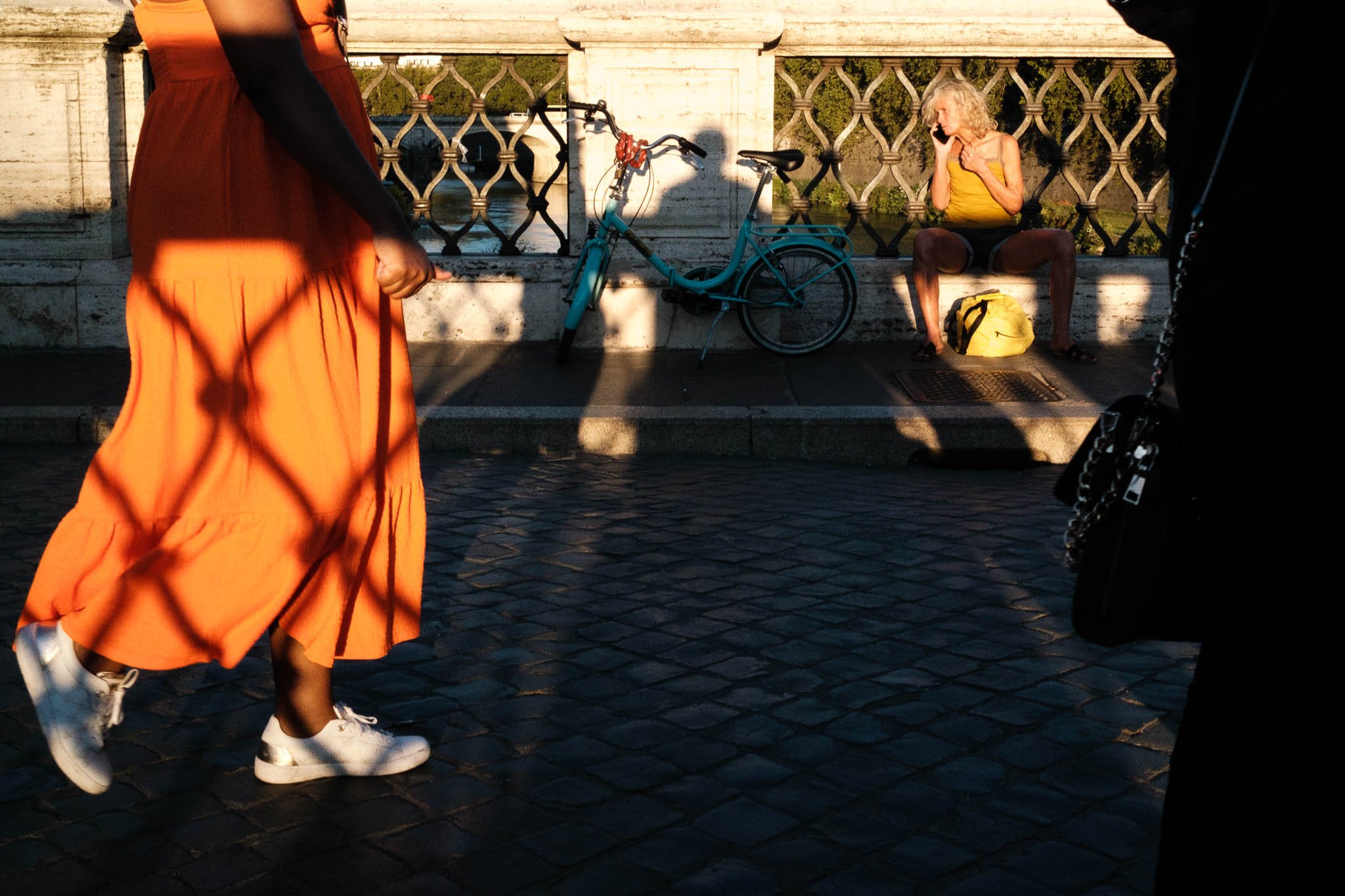
Rome, Bem Cremin
There is a quieter version of the same threat, and it doesn't need a new law to take hold. A lot of what looks like civic space in British towns and cities, squares, plazas, station concourses, shopping precincts, is privately owned land dressed up as a street. These are known as privately owned public spaces, or POPS. The owner can restrict photography there and ask people to stop or leave, even though the space looks and functions like the public square it replaced. None of that is illegal. But as more shared life moves into managed, privately owned space, the right to record that life moves with it, into the hands of whoever owns the land.

Rome, Ben Cremin
The real stake here has very little to do with photography as art. It is about who gets to make a visual record of public life, and on what terms. A society where that record can only be made with official permission is a society where power gets to decide what gets remembered, whether that is a state suppressing footage of an incident or a landowner clearing photographers out of a square that looks public but isn't. The UK's default position, that no one needs permission to make that record, does more democratic work than it tends to get credit for.